INTRODUCING NEW CONDITIONS POST-LOI

Introducing New Conditions Post-LOI in Canadian Lower Middle Market M&A: A Seller's Playbook for Buyer Buy-In
In the high-stakes arena of Canadian lower middle market mergers and acquisitions—where deals often range from $5–$50 million—signing a Letter of Intent (LOI) feels like crossing the Rubicon. It locks in exclusivity (typically 30–90 days), signals mutual commitment, and sets the stage for due diligence. But here's the reality: LOIs are mostly non-binding on core commercial terms, acting more as a flexible blueprint than an ironclad pact. This opens the door for sellers to introduce new conditions post-LOI—think a lease extension, key employee incentives, or fresh environmental warranties—without derailing the process outright.
Yet, in a market where trust fuels 70–80% of these relationship-driven transactions, springing a surprise can backfire, breeding doubt or even deal-killers. With 2025's economic crosswinds—like persistent inflation and U.S. tariff threats—buyers are savvier and more risk-averse than ever. The art? Presenting your condition as a value-adding refinement, not a roadblock. Grounded in Canadian legal norms (e.g., good faith duties under provincial contract laws like Ontario's Sale of Goods Act) and federal guardrails (e.g., Competition Act thresholds), this guide equips sellers with a step-by-step playbook to secure buyer nod without losing momentum.
The Post-LOI Pivot: Why It Happens and Why It's Fair Game
Diligence is a revelation machine—uncovering gems like a supply chain vulnerability or a regulatory curveball that demands tweaks. Since LOIs bind only on sideshows (e.g., no-shop covenants and confidentiality), the meaty stuff like conditions precedent stays in play until the Share Purchase Agreement (SPA) crystallizes. In lower middle market deals, where timelines squeeze into 3–6 months, 70–80% of LOIs morph during this window, according to recent benchmarking from Canadian advisory firms.The seller's edge? Frame the condition as a mutual safeguard—e.g., "This lease reset de-risks your ops by two years, based on fresh market data." Done right, it fortifies the deal; botched, it invites walkaways. Let's map the path to consensus.
Your Step-by-Step Guide: Proposing the Condition Without the Pushback
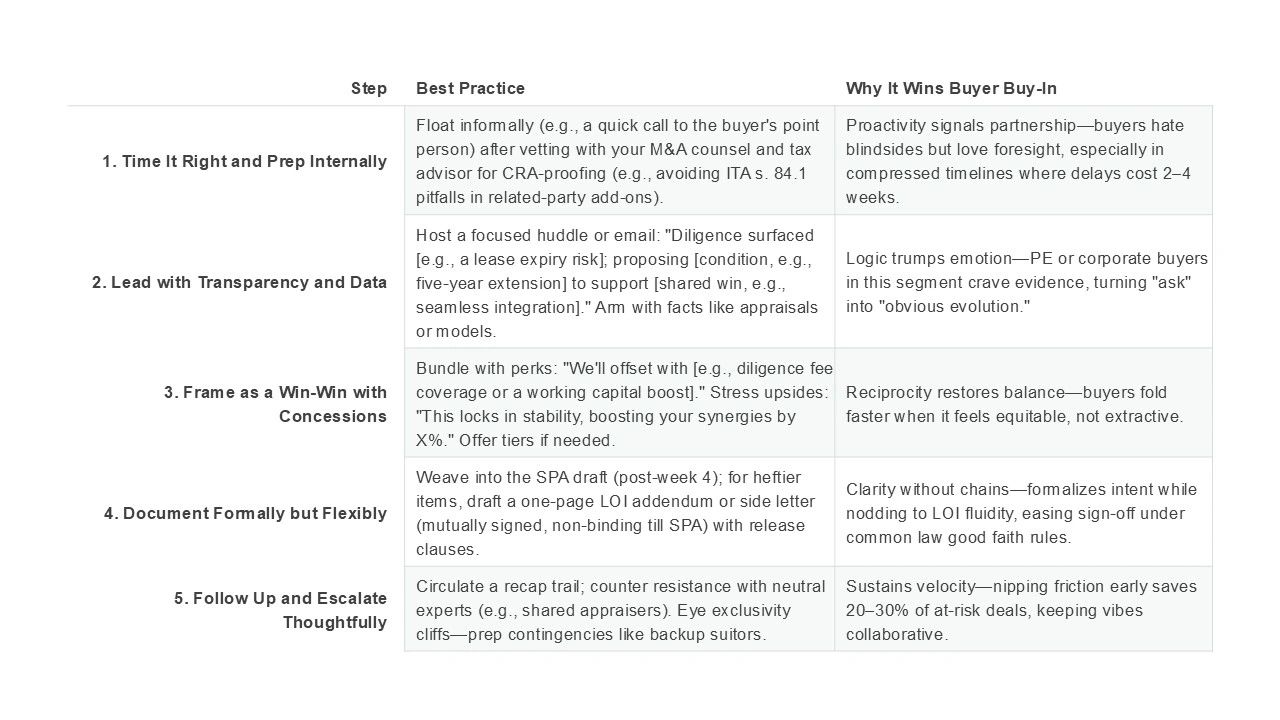
Timing and tone are everything. Launch early (weeks 1–4 of exclusivity) via relational channels, then formalize. Here's the blueprint:
The Pitfalls: Common Risks and How to Sidestep Them
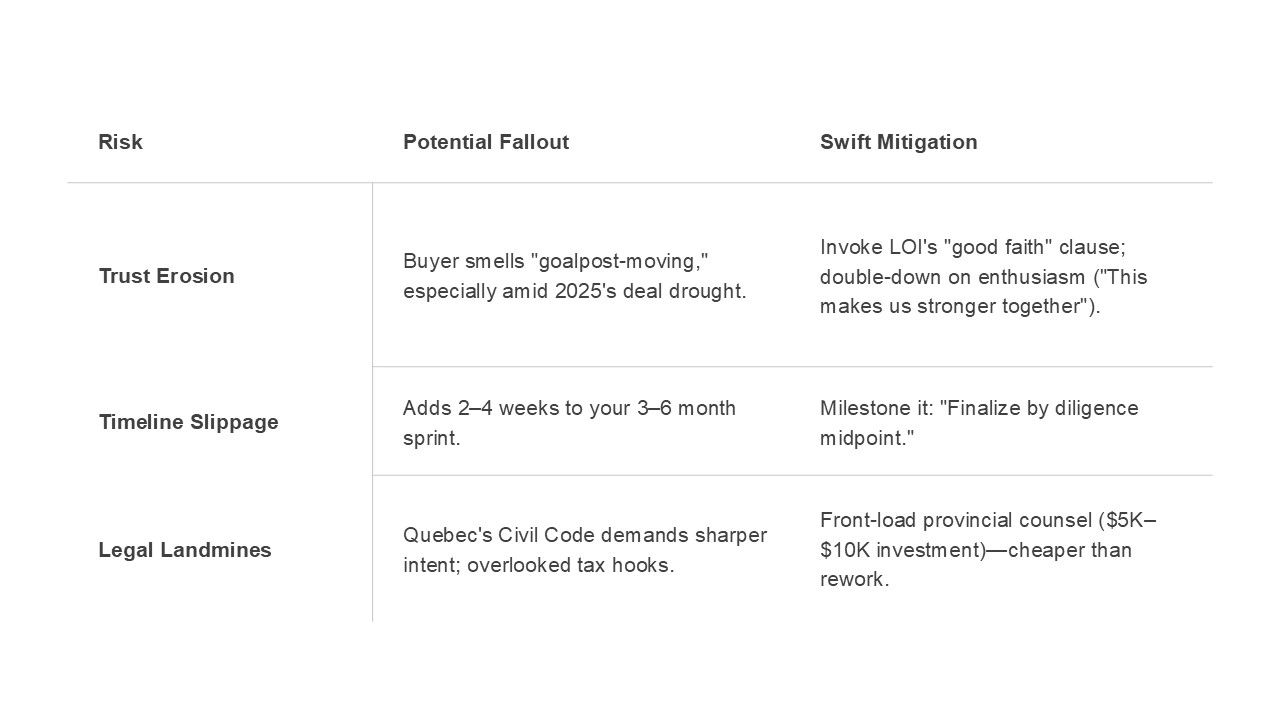
Even polished proposals can snag. Here's a quick risk radar:
Pro Tips: Tailoring for Lower Middle Market Wins in 2025
- Harness Networks: With 60% of Canadian deals born from intros, lean on pre-LOI rapport to soft-land the pitch.
- Trend-Spot: Tariff jitters are spiking supply chain conditions, benchmark against peers for relevance.
- Know When to Fold: For price-tweaking bombshells, probe pre-LOI to dodge exclusivity jams.
Wrapping Up: Turn the Pivot into Progress
A post-LOI condition isn't a grenade—it's a gear shift that can supercharge certainty when pitched as a team sport. In Canada's lower middle market, where agility trumps absolutism, mastering this keeps deals alive and thriving.
Disclaimer: This isn't legal, tax, or financial advice—always rope in qualified pros for your specifics.