NAVIGATING TARIFF TURBULENCE

Navigating Tariff Turbulence: How Earnouts and Vendor Notes Can Safeguard Your Canadian Business Sale
By the Selling Your Canadian Business Team | November 24, 2025
As a Canadian business owner with revenues between $5 million and $50 million CAD, you've built something remarkable. Your company isn't just a ledger of numbers, it's a legacy of innovation, grit, and market savvy. But let's be real: the shadow of U.S. tariffs is looming large over your future. With President Trump's administration ramping up duties on everything from steel and aluminum (up to 50%) to automobiles (25%) and softwood lumber (35%), your export-dependent operations could face squeezed margins, disrupted supply chains, and uncertain revenue streams. Despite this volatility, many owners like you are eyeing an exit. Why wait for the storm to hit when you can sell now and structure a deal that shares the weather risks?
The good news? Tools like earnouts and vendor notes (also called seller financing) are proven ways to bridge the valuation gap between your optimistic projections and a buyer's tariff-wary caution. These mechanisms let you capture upside potential while giving financial and strategic buyers the downside protection they crave. In this post, we'll break down how to structure them effectively, tailored for mid-market Canadian sellers, to keep your deal alive and equitable.
The Tariff Threat: Why Your Exit Can't Wait
Flashback to early 2025: U.S. tariffs under the International Emergency Economic Powers Act (IEEPA) kicked in on March 4, slapping 25% duties on broad swaths of Canadian exports, with escalations to 35% by August. Canada fired back with counter-tariffs on $60 billion in U.S. goods, but the net effect? Heightened inflation risks, job losses in export-heavy sectors, and a projected 0.1-0.2% drag on Canadian GDP. For businesses in manufacturing, autos, or resources, common in the $5-50M revenue bracket, this means future EBITDA forecasts are as reliable as a weathervane in a gale.
Buyers know this. Strategic acquirers (e.g., U.S. competitors) worry about retaliatory measures eroding synergies, while financial buyers (private equity) see tariffs inflating working capital needs and compressing multiples. Result? Stalled deals or lowball offers that undervalue your pre-tariff momentum.
Enter earnouts and vendor notes: They're not just accounting tricks—they're risk-sharing superpowers. By tying payments to post-closing performance, you align incentives and turn uncertainty into a collaborative hedge.
Earnouts: Betting on Your Business's Resilience
An earnout defers a portion of the purchase price (typically 10-30% of total value) to be paid only if your business hits predefined milestones after the sale. In a tariff-hit world, this is gold for balancing optimism with realism.
Why Earnouts Work for Tariff-Exposed Sellers
- Protects Your Upside: If tariffs fizzle (e.g., via Supreme Court rulings or a new CUSMA deal), your strong execution can trigger bonus payments, validating your vision.
- Eases Buyer Hesitation: Financial buyers love earnouts for capping exposure, pay only for proven results. Strategic buyers use them to lock in talent (you) without overpaying for "what ifs."
Structuring Earnouts for Balance
To avoid disputes (earnouts fail 20-30% of the time due to poor drafting), keep it simple, measurable, and tariff-proof. Here's a blueprint:
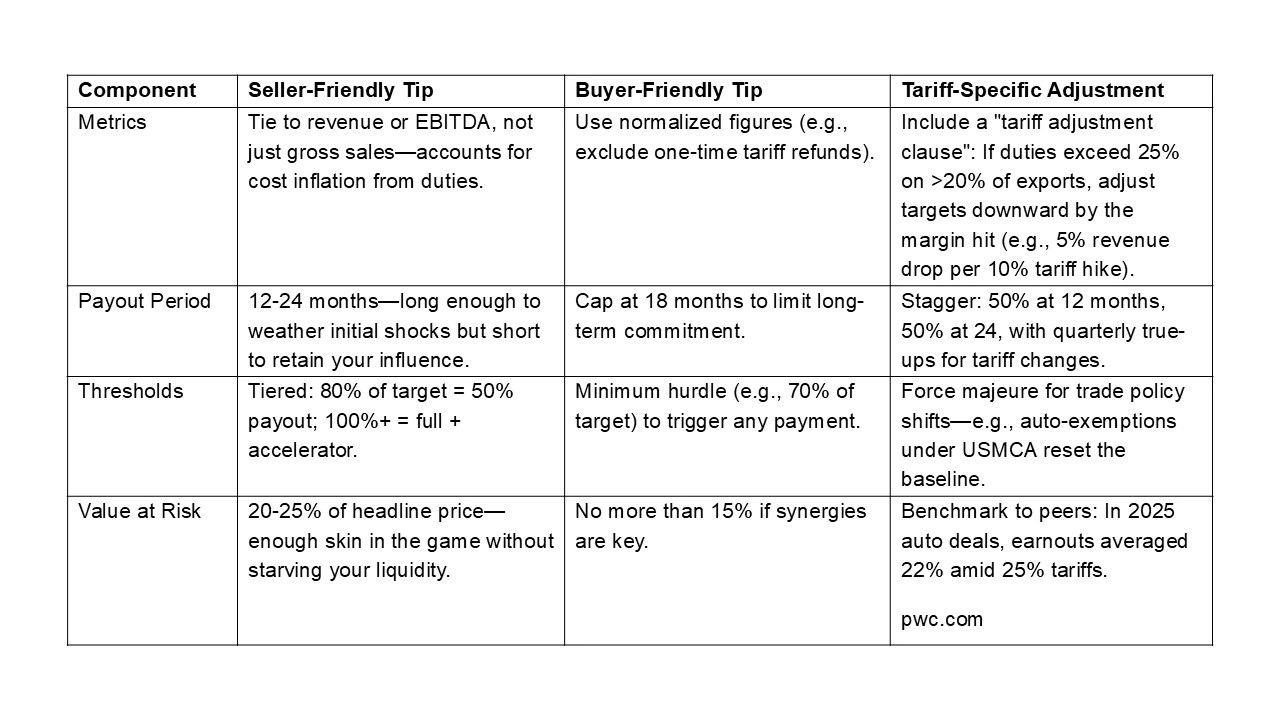
Pro Tip: Audit rights are non-negotiable. Sellers get veto on "extraordinary" costs (like rushed supply chain pivots), while buyers insist on transparency. In our experience, clear definitions prevent 80% of post-close fights.
Vendor Notes: Financing the Bridge to Stability
If earnouts feel too performance-tied, vendor notes let you act as your own banker. You loan the buyer 10-40% of the price, repaid over 3-7 years with interest (5-8% typical). It's seller financing with teeth, securing your payout while giving buyers cash-flow breathing room.
The Tariff Angle
Tariffs spike costs now but could ease with diversification (Canada's eyeing China/India ties to offset U.S. reliance). Vendor notes buy time for that pivot, with repayments flowing as stability returns.
Key Structures for Risk Balance
- Principal and Interest: Amortizing (equal payments) for steady seller income; interest-only bullet for buyer flexibility. Add 1-2% premium if tariffs persist.
- Security: First lien on assets, protects you if the buyer falters. Subordinate to bank debt, but with covenants limiting further leverage.
- Prepayment Options: Buyer can pay early (no penalty post-Year 2) if tariffs lift, rewarding quick wins.
- Default Triggers: Miss payments? Acceleration clause. But include tariff carve-outs;e.g., no default if EBITDA drops 15% due to verified duties.
- Hybrid with Earnouts: Layer them! 15% vendor note + 15% earnout = diversified risk, common in 2025 cross-border deals.
For a $20M business, this might look like: $14M cash at close, $3M vendor note (5-year, 6% interest), $3M earnout (revenue-based, tariff-adjusted).
Making It Work: Negotiation Must-Haves
- Model Scenarios: Run pro formas with tariff baselines (25% on exports) vs. best-case (0% via deal).
- Legal Safeguards: Use Canadian M&A lawyer versed in IEEPA implications. Include reps on tariff compliance.
- Tax Smarts: Earnouts often qualify as capital gains; notes as interest income, structure to minimize your hit.
- Exit Your Way: Retain a consulting role for earnout influence, but cap it to avoid non-compete traps.
The Bottom Line: Sell Smart, Not Scared
Tariffs are testing Canada's trade mettle, but they're not deal-killers, they're deal-shapers. By weaving earnouts and vendor notes into your LOI, you honor your business's potential while meeting buyers where they are: cautious but committed.
Disclaimer: This post is for informational purposes only and not legal or financial advice. Consult professionals for your situation.