Selling a business 101: What I shared on stage at BTF Vancouver

Selling a business 101: What I shared on stage at Business Transitions Forum Vancouver
Earlier this week I had the privilege of joining a panel at Business Transitions Forum Vancouver on a topic that sits at the core of everything I do: Selling A Business 101 — Exploring The Basic 'Who, When, What & How' Of Transition.
The room was full of business owners, advisors and intermediaries. The questions were sharp. The conversations in the hallways afterward were even sharper. What struck me was not how much people knew — it was how much remained unclear, even among owners who believed they were close to ready.
So I want to put into writing what I shared on stage. Not a polished version with all the rough edges smoothed out, but the actual substance — the four questions every business owner must answer before they can seriously contemplate a sale.
Canada is standing at the edge of the largest business ownership transition in its history. According to the Canadian Federation of Independent Business (CFIB), three in four Canadian business owners plan to exit within the next decade — a transfer of more than $2 trillion in business assets that will reshape the economic landscape from coast to coast. Yet despite the scale of what is coming, most owners are not ready.
A 2025 MNP LLP Succession Readiness Report found that nearly two-thirds of Canadian entrepreneurs ( 64.1 per cent ) have not formalized a succession plan, and fewer than one in 10 (8.5 per cent) have set clear, actionable goals for their exit.
These are not abstract statistics. They describe the people who were sitting in that room in Vancouver. They may describe you.
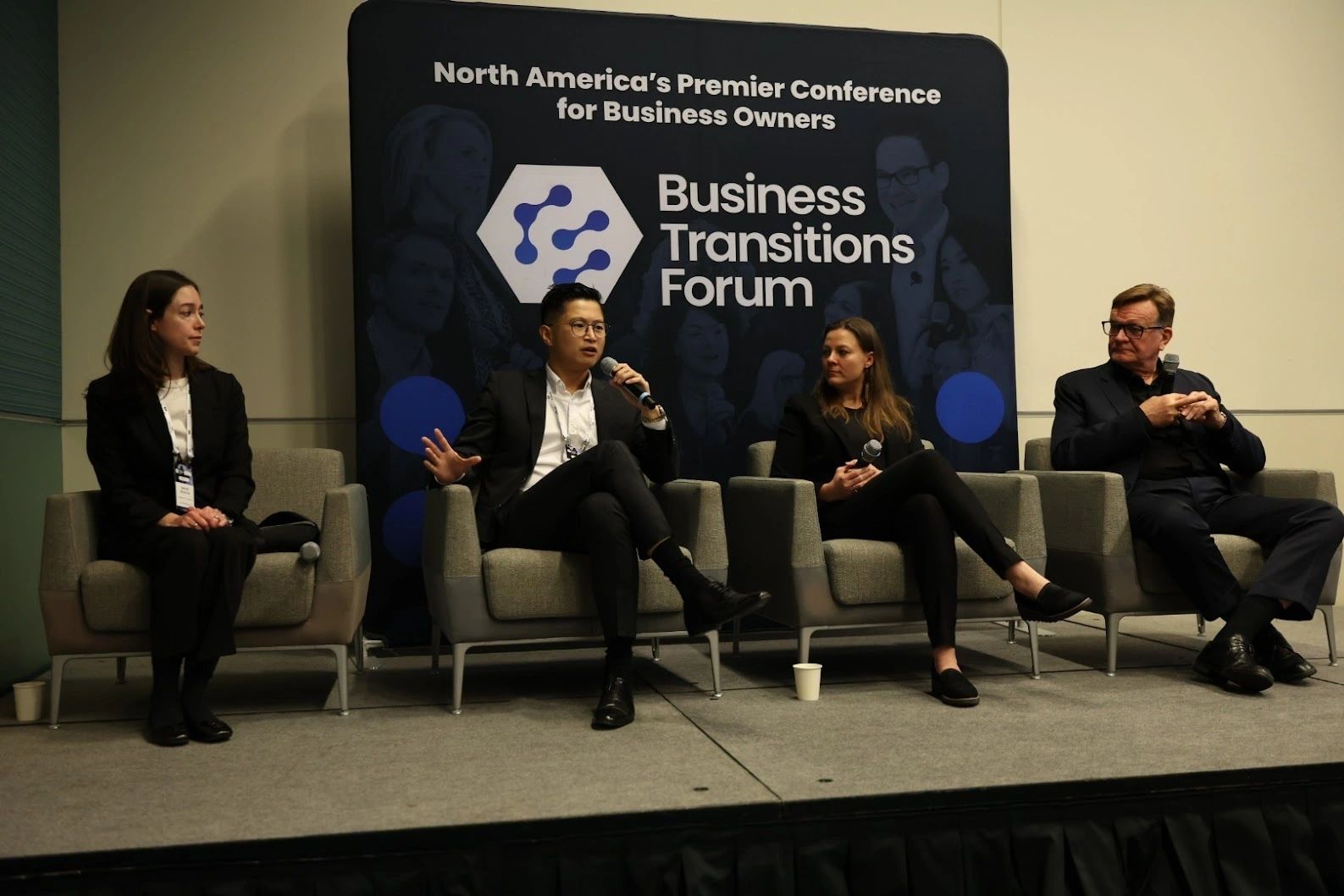
Who: Who is actually doing the selling?
This was the first question the moderator put to the panel, and it is the one that reveals the most about a seller's readiness.
In the lower middle market ( businesses generating between $5 million and $50 million in annual revenue ) the seller is almost always a founder or first-generation entrepreneur. That distinction matters enormously, because founder-led businesses carry a particular set of risks that third-party buyers scrutinize closely.
Chief among them is owner dependency. MNP's research found that 39 per cent of business owners identified their company's reliance on them for day-to-day operations as one of the biggest obstacles to a successful succession. I have seen this pattern more times than I can count. The owner is the business, the relationships, the institutional knowledge, the sales process, the client trust. When a buyer looks at that, they see risk. And risk means a lower price, or no deal at all.
I told the audience in Vancouver: before you ask what your business is worth, ask whether your business can function without you. If the honest answer is no, that is where the work begins.
Understanding who you are as a seller also means understanding your motivations. According to the CFIB, around 75 per cent of business owners will exit for retirement, approximately 22 per cent will leave due to stress, and about 21 per cent will step back from ownership responsibilities. Each of those motivations produces a different kind of seller, different in patience, different in flexibility, different in what a deal needs to accomplish. A buyer can sense that difference. Your advisor needs to understand it before anyone else does.
Finally, the "who" question extends to your team. About two in five business owners (39 per cent) rely solely on themselves to develop a succession plan rather than engaging an accountant, lawyer or qualified business advisor. I said on stage what I believe completely: successfully exiting a business is rarely accomplished alone. A qualified M&A advisor, tax counsel familiar with Canadian structures and a legal adviser experienced in share purchase agreements are not optional, they are the difference between a transaction that closes at full value and one that collapses at due diligence.

When: The answer most owners do not want to hear
The moment this question came up on stage, I could feel the room lean in. Everyone wants to know: is now a good time to sell?
My answer is always the same. The more important question is: how long ago should you have started preparing?
The answer most advisors give, and the one I gave in Vancouver, is three to five years before you intend to sell. That advice is not arbitrary. A business positioned for sale looks fundamentally different from a business simply being operated. Value drivers, recurring revenue, management depth, documented processes, clean financials and customer diversification, are not features you can add in a weekend. They take years of deliberate effort to build and demonstrate credibly to a buyer.
A 2024 Ontario Chamber of Commerce survey found that 73 per cent of business owners in Ontario do not have a completed succession plan. Owners who wait until retirement is imminent find themselves with limited options: fewer buyers, compressed timelines, weaker negotiating leverage and no runway to address the issues a buyer's due diligence will inevitably uncover.
There is also the issue of external events upending internal timelines. Nearly 40 per cent of owners have altered their exit timeline following the financial and emotional toll of the COVID-19 pandemic — some delaying due to lower valuations, others accelerating due to stress or health concerns. Unexpected life events are the most common reason owners are forced to sell on someone else's schedule, not their own.
I said something on the panel that seemed to land: the best time to plant a tree was 20 years ago; the best time to start your exit plan was three years ago. The second-best time is today.

What: You are not selling what you think you are selling
Of the four questions on the panel, this is the one that generated the most pushback, and, I suspect, the most reflection after the session ended.
Most business owners believe they are selling their business. In practice, a buyer is evaluating a bundle of assets, risks, cash flows and future potential, and the price they offer reflects how they see that bundle, not how the seller feels about it.
In a typical lower middle-market transaction, the core of what transfers includes the operating business and its brand, customer contracts and relationships, intellectual property and proprietary systems, key employees and management, equipment and inventory and — most importantly — the earnings history that justifies the purchase price.
That last point is where most deals are made or broken. Buyers will scrutinize your normalized EBITDA (earnings before interest, taxes, depreciation and amortization) and apply a multiple based on industry, growth trajectory, risk profile and current market conditions. A Quality of Earnings analysis, typically conducted by an independent accounting firm, is increasingly standard in Canadian lower middle-market transactions and will validate or challenge the earnings picture you present.
Equally important is the structure of what is sold. Canadian tax law draws a sharp distinction between a share sale and an asset sale. For most sellers, a share sale is preferable because it allows access to the Lifetime Capital Gains Exemption (LCGE). The LCGE was raised to $1.25 million per individual in the 2024 federal budget, allowing eligible owners to shelter up to that amount in capital gains when transferring or selling their business, significantly easing the tax burden.
To qualify for the LCGE, the business must be active and Canadian-controlled, the sale must be structured as a share sale rather than an asset sale, and passive assets such as real estate or investments may need to be purified first. This kind of tax planning is not a detail to address at closing. It requires years of corporate housekeeping — which is, again, why when matters so much.
How: What the process actually looks like
The last question on the panel was the most practical; and the one I spend the most time on in my advisory work. I walked the room through six stages that define a well-run sell-side process. Here is what I covered.
Stage 1 — Preparation (six to 18 months before going to market)
This is where value is created, not discovered. Preparation involves normalizing your financial statements, addressing owner dependency, documenting operational processes, resolving any outstanding legal or regulatory issues, and ensuring your corporate structure is optimized for a tax-efficient sale. Your M&A advisor will help you develop a Confidential Information Memorandum, the primary marketing document shared with prospective buyers.
Stage 2 — Buyer identification and outreach
The majority of respondents in MNP's survey ( 54 per cent ) said finding a suitable buyer is the biggest obstacle to succession planning, followed closely by business valuation at 43 per cent and reliance on the owner for day-to-day operations at 39 per cent. A structured sell-side process, where your advisor proactively approaches a curated universe of strategic and financial buyers, produces better outcomes than passively waiting for an offer.
Stage 3 — Letters of Intent and exclusivity
Qualified buyers submit a non-binding Letter of Intent outlining price, structure and key terms. Once you accept one and enter exclusivity, the buyer has the right to conduct full due diligence. Selecting the right LOI is not simply about the highest number, — deal structure, certainty of close, earnout terms and cultural fit all matter.
Stage 4 — Due diligence
Expect 60 to 90 days of rigorous examination. Buyers and their advisors will review financial statements, customer contracts, employee agreements, IP ownership, regulatory compliance, environmental assessments and any pending litigation. The quality of your preparation in Stage 1 determines how smoothly this stage proceeds.
Stage 5 — Definitive agreement and closing
Your legal team negotiates the share purchase agreement, including representations and warranties, indemnification provisions and closing conditions. Representations and warranties insurance is increasingly common in lower middle-market deals and can reduce the escrowed holdback a seller must leave in trust post-closing.
Stage 6 — Transition
Most buyers will require the seller to remain involved for a defined transition period, typically three to 12 months, to facilitate knowledge transfer and preserve customer and employee relationships. Earnout provisions, where a portion of the purchase price is contingent on post-closing performance, may extend this engagement further.
What I took away from Vancouver
Panels are a two-way exchange. You prepare your talking points, and then the room teaches you something you did not expect.
What I heard clearly in Vancouver, — in the questions from the floor, in the hallway conversations, and in the sidebar discussions over lunch, is that business owners are not suffering from a shortage of information. They are suffering from a shortage of organized information delivered in a way that maps to the actual decisions they face.
The national task of transferring three-quarters of Canada's SMEs to new hands needs to get underway now. Stranded assets and failed business sales are not just a seller's problem — they represent a failed opportunity for the entire economy, according to CIBC's Thought Leadership research.
For the individual owner, the stakes are more personal. Your business is very likely the largest asset you will ever sell. Done well, a sale delivers the retirement you planned for, preserves the legacy you built and protects the employees who helped you build it.
I am writing a book on this subject; a comprehensive, step-by-step guide to selling a Canadian business, written specifically for lower middle-market owners navigating this process for the first time. It is not published yet, but the early access waitlist is open. If the four questions in this article resonate with where you are in your thinking, the book goes considerably deeper on every one of them.
Join the waitlist: [sellingyourcanadianbusiness.ca]
Sources cited
- Canadian Federation of Independent Business (CFIB) — https://www.cfib-fcei.ca
- MNP LLP, Succession Readiness Report (Feb. 2025) — https://www.lexpert.ca/news/finance-law/mnp-report-reveals-succession-planning-gap-poses-risk-to-canadian-businesses-and-jobs/391319
- MNP LLP, What Canada's aging population means for your succession plan — https://www.mnp.ca/en/insights/directory/canadas-aging-population-mean-for-your-succession-plan
- Ontario Chamber of Commerce, 2024 — https://occ.ca
- WealthCo Group, Why succession planning in Canada matters now in 2025 — https://www.wealthco.ca/insight-list/why-succession-planning-in-canada-matters-now-in-2025-more-than-ever
- DealFlow Canada, The Canadian family business succession and valuation guide — https://www.dealflowcanada.com/p/the-canadian-family-business-succession
- CIBC Thought Leadership, The economic case for getting business succession right — https://thoughtleadership.cibc.com/article/the-economic-case-for-getting-business-succession-right/
- The Future Economy, Business succession: navigating the exodus of small business owners — https://thefutureeconomy.ca/op-eds/business-succession-planning-shane-murphy-ownr/
- Vistance Accounting, The succession crisis: why many Canadian business owners aren't ready to sell — https://vistanceaccounting.com/the-succession-crisis-why-many-canadian-business-owners-arent-ready-to-sell/
- Statistics Canada — https://www.statcan.gc.ca
- Canada Revenue Agency, Lifetime Capital Gains Exemption — https://www.canada.ca/en/revenue-agency