IN A BUSINESS SALE, SILENCE IS NOT EMPTY SPACE

The most underused tool in any negotiation costs nothing, requires no preparation and is available to every seller at every moment. Most Canadian business owners never use it because the discomfort of not filling it is more than they can bear — and experienced buyers know exactly how to exploit that.
This is article 6 of 8 in a series examining the foundational negotiating strategies documented by academic and practitioner research, and comparing the relative strengths and weaknesses of owner-direct versus advisor-led negotiation in Canadian lower-middle-market business sales. Each article draws on peer-reviewed research, transaction data and more than 30 years of Canadian M&A advisory experience.
What silence actually is in a negotiation
In ordinary conversation, silence is a gap. Something has gone wrong. Someone forgot what they were going to say. The natural response is to fill it, quickly, so that the social interaction can resume its normal rhythm.
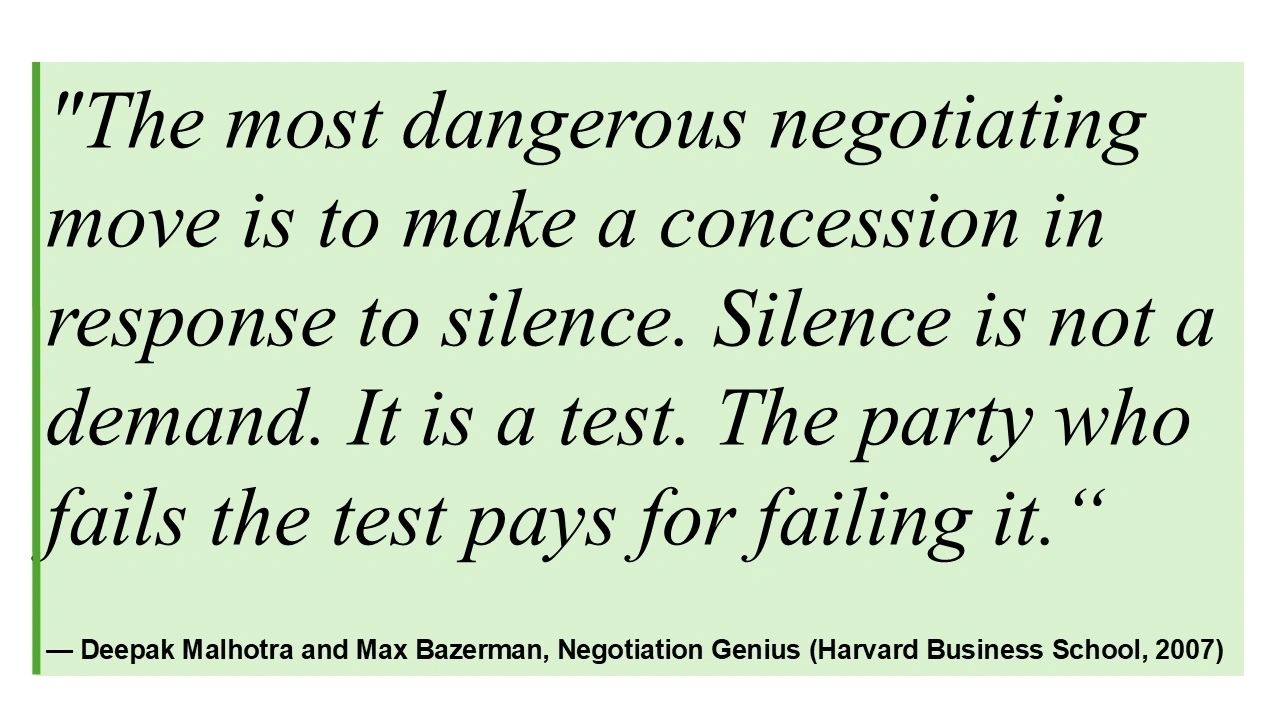
In a negotiation, silence is something entirely different. It is pressure. Deliberately applied, professionally sustained and almost always filled by the party with the most to lose from the discomfort of not speaking.
This is not a matter of personality or conversational style. It is a well-documented psychological dynamic with a consistent and predictable outcome. When one party in a negotiation makes an offer, a demand or a concession and then goes quiet, the other party experiences a compulsion to respond. That compulsion, if the responding party lacks the discipline to resist it, produces one of the most reliable patterns in negotiation: the self-inflicted concession.
The self-inflicted concession is what happens when a seller states an asking price, meets silence from the buyer and then, unable to tolerate the absence of a response, begins softening their own position before the buyer has said a single word. "Of course, we could discuss the structure." "I know multiples have been under some pressure this year." "There may be some flexibility depending on how the earnout is designed." Each of these statements is a concession. None of them was requested. All of them were produced by the seller's inability to sit in silence and wait.
The psychology behind why silence is so hard to hold
Understanding why silence is so difficult in a high-stakes negotiation is the first step toward using it effectively.
The need for social affirmation
Human beings are social animals. We regulate our sense of how a conversation is going through the continuous exchange of signals: words, tone, facial expression, body language. When those signals stop, we become anxious. In the absence of feedback, we assume the worst: the other party is displeased, disengaged or about to walk away. That assumption generates urgent pressure to say something that restores the signal flow and confirms that the relationship is still intact.
In a business sale, an owner who has spent years building a company and is now negotiating its transfer experiences this social anxiety at a particularly acute level. The buyer's silence after an offer does not simply feel uncomfortable. It feels like a rejection of everything the owner has built. The instinct to fill that silence with reassurance, explanation and accommodation is almost overwhelming.
The attribution error
A related dynamic is what psychologists call the attribution error: the tendency to interpret the behaviour of others as reflecting their internal states rather than their strategic choices. When a buyer goes silent after receiving an offer, the seller tends to interpret that silence as displeasure with the offer. In many cases, however, the silence is entirely deliberate. The buyer is simply waiting to see what the seller will do next, knowing from experience that sellers rarely hold silence for long and that what comes next is usually more favourable than the original offer.
The seller who interprets silence as displeasure and responds by softening their position has made a costly attribution error. The buyer was not displeased. The buyer was patient. The difference in outcome is significant.
The urgency asymmetry
In most lower-middle-market business sale negotiations, there is a meaningful asymmetry in urgency between buyer and seller. The seller has one business to sell. The buyer has multiple acquisition targets, a team of analysts continuously generating new opportunities and a mandate to deploy capital across a portfolio of transactions. The seller's timeline is driven by personal objectives: retirement plans, health considerations, market timing or family circumstances. The buyer's timeline is driven by fund deployment schedules that are flexible across multiple investments.
This asymmetry means that silence is almost always more comfortable for the buyer than for the seller. The buyer can wait. The seller feels the cost of waiting in a way the buyer does not. Experienced buyers use this asymmetry deliberately, allowing silence to accumulate until the seller's urgency converts into accommodation.
RESEARCH NOTE: Research by the Harvard Program on Negotiation confirms that silence following an offer is one of the most consistently effective and systematically underused tools available to sellers in a negotiation. The research documents that most concessions in a negotiation are not produced by persuasion but by the responding party's discomfort with the absence of a response. Holding silence after stating a position is a discipline that experienced negotiators develop deliberately over time. Source: pon.harvard.edu/daily/negotiation-skills-daily/the-power-of-silence-in-negotiation
How buyers use silence as a tactical weapon
The delayed response
One of the most common silence tactics in lower-middle-market M&A is the delayed response to a seller's offer or counter-proposal. The buyer receives the seller's position and simply does not respond for several days. No acknowledgement. No timeline for a response. No signal of any kind about whether the offer is being considered favourably or not.
For an owner negotiating directly, this silence is excruciating. The business continues to operate. Employees are curious about the transaction's status. The owner's advisors and family are asking for updates. The absence of any signal from the buyer is experienced as an enormous void, and the temptation to reach out, to check in, to ask whether everything is alright, to indicate that there may be some flexibility on certain points, is very difficult to resist.
When the buyer does respond, often after the seller has reached out with a softening message, they are negotiating against a seller whose position has already moved without any counteroffer being made. The delay cost the seller value that the seller gave away voluntarily.
The silence after a concession
A second tactical deployment of silence occurs immediately after the buyer has made a concession or improved their offer. The natural response from a seller is gratitude and reciprocity: the buyer moved, so the seller should acknowledge the movement positively and signal willingness to move in return.
An experienced buyer making a concession will sometimes go quiet after doing so, waiting to see whether the seller's reciprocity instinct will produce a voluntary improvement in the seller's position before any further negotiation has occurred. A seller who says "that is helpful, and we could probably work with something in that range, perhaps with some flexibility on the earnout" has conceded twice: once by accepting the buyer's move as sufficient progress and once by volunteering additional flexibility that was not requested.
The correct response to a buyer concession is silence, or at most a neutral acknowledgement that the concession has been noted and will be considered. Anything more is a gift.
The late-stage silence
The most damaging deployment of silence as a tactic occurs in the final stages of a transaction, when the seller's psychological investment in completion is at its highest. After months of negotiation, due diligence and relationship development, the buyer introduces a late-stage issue, a due diligence finding, a working capital adjustment request or a reps and warranty concern, and then goes quiet. The silence arrives at exactly the moment when the seller can least afford to walk away and most wants to hear that everything is still on track.
The seller who fills this silence with accommodation, adjusting price, expanding indemnification or accepting unfavourable earnout modifications to keep the deal moving, is conceding at the point in the process where the cost of concession is highest and the pressure to concede is most intense. This pattern is so consistent in owner-direct negotiations that experienced lower-middle-market buyers have built it into their standard acquisition process.
When the owner negotiates directly: silence as a systematic vulnerability
The over-talking pattern
Business owners are typically articulate, persuasive advocates for their companies. They have spent years making the case for their business to customers, employees, investors and bankers. Talking about the business is natural, comfortable and usually productive.
In a negotiation, these same qualities become a liability. An owner who is fluent and confident talking about their business will fill silences with exactly the kind of elaboration, justification and contextualizing that experienced buyers use to assess flexibility and identify the edges of the seller's position. Every sentence spoken after a price has been stated is potentially a signal about where the actual floor is. Every explanation offered for why the asking price is what it is contains information about the conditions under which the owner might accept less.
The over-talking pattern is not a personality flaw. It is a natural extension of behaviours that serve the owner well in every other business context. In a negotiation, it is expensive.
Real-time conversation removes structural silence
There is a deeper problem with silence in owner-direct negotiations that goes beyond individual discipline. Direct, real-time conversations between owner and buyer remove the structural silences that a formal advisory process builds in by design.
In a face-to-face meeting or a telephone negotiation, silence lasts seconds before one party or the other fills it. There is no natural pause in which the seller can process a buyer's response, consult advisors, model the implications of different positions or simply wait out the buyer's patience. The conversational format itself creates relentless pressure to respond immediately, and immediate responses are almost always less strategically considered than responses that follow a period of deliberate reflection.
What owner-direct negotiation does well here
There is a narrow circumstance in which an owner negotiating directly can use silence effectively: one-on-one, in person, with a buyer whose patience they have correctly assessed and whose use of silence as a tactic they have specifically prepared for.
Some owners are naturally comfortable with extended silence and use it instinctively. These individuals exist, and in the right context they can hold silence as effectively as any professional negotiator.
The problem is that most owners do not know in advance whether they have this capability until they are already in the room, and discovering mid-negotiation that they cannot hold silence is an expensive way to find out. The consequences of getting it wrong are asymmetric: the upside of deploying silence well is modest, while the downside of filling silence with unintended concessions is substantial.
When an M&A advisor negotiates on your behalf: silence as structural design
Written communication as default silence
The most important silence advantage in advisor-led negotiation is not about individual discipline at all. It is structural. An M&A advisor communicates with buyers primarily in writing: through process letters, term sheets, bid instructions, due diligence response memoranda and formal correspondence. Written communication is silence by default. The buyer receives the seller's position and has no real-time visibility into the seller's reaction while they consider their response.
There is no facial expression to read. No tone of voice to interpret. No pause in the conversation that creates pressure to fill it. The buyer's response arrives when it arrives, and in the interval between the seller's communication and the buyer's reply, the seller has time to reflect, consult and consider rather than react. This structural silence is not a discipline that must be maintained under pressure. It is an automatic feature of the communication format.
The bid process as enforced silence
In a structured competitive sale process, formal bid rounds create enforced silence that serves the seller's interests directly. After submitting an information memorandum or inviting indications of interest, the advisor imposes a defined period during which buyers evaluate the materials and prepare their responses. The seller does not check in. The seller does not provide updates. The seller does not signal impatience or flexibility during the evaluation period.
This enforced silence achieves two things simultaneously. It prevents the seller from inadvertently undermining their position during the evaluation period. And it creates exactly the kind of buyer anxiety that silence in a direct negotiation is intended to create, amplified across multiple buyers simultaneously and sustained for a defined period rather than a few uncomfortable seconds.
Managing the owner's silence psychology
An advisor also plays an important role in managing the owner's own experience of silence during the negotiation process. When a buyer goes quiet after receiving an offer, when a deadline passes without response, when a due diligence period extends without updates, the owner's anxiety is real and the temptation to reach out is powerful.
The advisor absorbs that anxiety, interprets the silence for the owner and advises on whether and how to respond. In most cases, the correct advice is to wait. The advisor can deliver that advice with the professional detachment that the owner, whose financial future and personal legacy are at stake, cannot easily apply to themselves. The owner does not need to develop the psychological discipline to hold silence personally. The advisor holds it on their behalf.
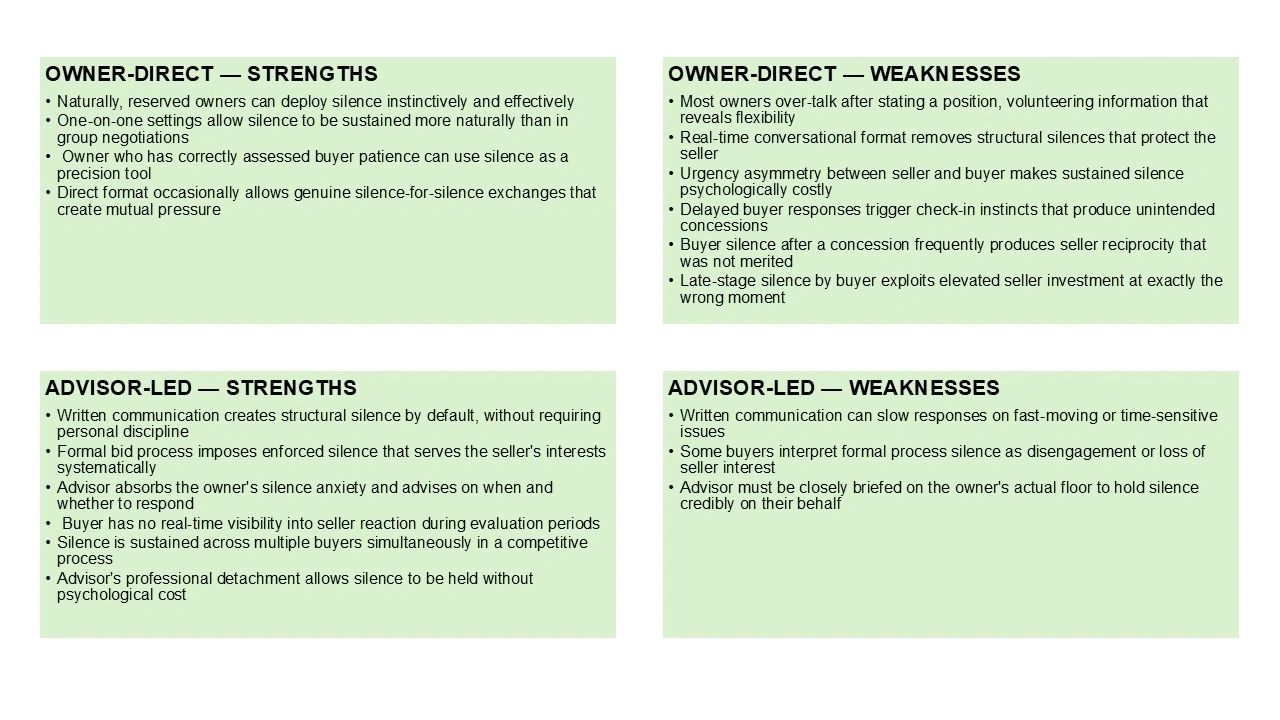
Head-to-head: strategic silence in owner-direct versus advisor-led negotiations
The discipline in practice
Strategic silence is deceptively simple. The instruction is: after stating your position, stop talking. Do not elaborate. Do not justify. Do not contextualise. Do not reassure. Say what you have to say, clearly and with conviction, and then be quiet.
The difficulty is not intellectual. Everyone understands the principle immediately. The difficulty is behavioural, because everything in a high-stakes social situation pushes against it. The anxiety of not knowing what the buyer is thinking, the social discomfort of an unresolved exchange, the fear that silence signals rigidity rather than confidence, and the genuine uncertainty about whether the buyer is about to walk away all conspire to fill the silence before it has done its work.
The owners who hold silence most effectively in a direct negotiation tend to share one characteristic: they have prepared for it. They have decided in advance, specifically and deliberately, that after they state their price they will not speak again until the buyer does. They have rehearsed the physical experience of sitting in silence. They have identified the phrases they are most likely to default to and consciously removed them from their vocabulary for the duration of the conversation.
This level of deliberate preparation is available to any owner. It simply requires recognizing in advance that silence will be one of the hardest disciplines to maintain and treating it with the same preparation investment as any other aspect of the negotiation.
What this means if you are planning to sell your business
Three practical disciplines follow from the research on silence for Canadian business owners approaching a sale.
First, decide in advance what you will say and what you will not say. The instinct to elaborate, justify and reassure after stating a position is powerful and predictable. Neutralizing it requires identifying it before the negotiation begins and making a specific, deliberate commitment not to act on it.
Second, use writing wherever possible in the negotiation. Email, formal correspondence and written term sheets impose structural silence that real-time conversation cannot replicate. Every time you reduce the number of real-time conversations in a negotiation and replace them with written exchanges, you are buying yourself the processing time and the silence protection that professional negotiators use routinely.
Third, be honest with yourself about your ability to hold silence under sustained pressure. The late-stage silence deployed by an experienced buyer, when months of work are at stake and the finish line is in sight, is genuinely difficult to resist. If you are not confident that you can hold your position without filling that silence with accommodation, the structural silence that an advisor-led process provides by default is worth considerably more than the cost of obtaining it.
Sources and further reading
Harvard Program on Negotiation — The power of silence in negotiation pon.harvard.edu/daily/negotiation-skills-daily/the-power-of-silence-in-negotiation
Malhotra, D. and Bazerman, M.H. — Negotiation Genius (Bantam Books, 2007) amazon.com/Negotiation-Genius-Obstacles-Brilliant-Bargaining/dp/0553384112
Cialdini, R. — Influence: The Psychology of Persuasion (updated ed., Harper Business, 2021) amazon.com/Influence-New-Expanded-Psychology-Persuasion/dp/0062937650
Fisher, Ury and Patton — Getting to Yes (3rd ed., Penguin Books, 2011) amazon.com/Getting-Yes-Negotiating-Agreement-Without/dp/0143118757
Pepperdine University Private Capital Markets Report (2024) bschool.pepperdine.edu/institutes-centers/centers/applied-research/private-capital-markets
Axial — Why deals fall apart (2022) axial.net/forum/why-deals-fall-apart
Next in the series
Article 7 of 8 Control the process, not just the outcome: why the design of the sale process is the most consequential negotiating lever available to a Canadian business seller — and why it is almost entirely inaccessible to owners who negotiate directly.
The complete series
Click any article to read in full
Strategy 1 · Leverage & alternatives | BATNA — know your best alternative to a negotiated agreement
How competitive alternatives determine who holds power at the negotiating table, and why the development of a strong BATNA is fundamentally different in an owner-direct versus advisor-led process.
Strategy 2 · Opening position | Anchor first and anchor high
Who sets the opening number, and why that decision shapes the entire deal. The research on anchoring bias and what it means when an owner anchors without preparation, or fails to anchor at all.
Strategy 3 · Relationship management | Separate people from the problem
Why emotional entanglement is the most costlynegotiating error business owners make, and how professional buyers exploit it deliberately, through tactics that are entirely standard in their world and entirely unfamiliar in the owner's.
Strategy 4 · Deal structure | Focus on interests, not positions
How understanding what buyers actually want — rather than what they say they want, creates deal structures that maximize total value. Why positional bargaining leaves money on the table and interests-based negotiation finds it.
Strategy 5 · Offer construction | Multiple simultaneous offers of equivalent value
How presenting two or three complete deal packages simultaneously reveals buyer priorities without a single unilateral concession, and why the analytical preparation required to do it well is beyond most owner-direct negotiations.
Strategy 6 · Communication discipline | Strategic silence
The discipline of not talking, and why most owners unknowingly concede with every word they speak after making an offer. How an advisor-managed process builds silence structurally into the negotiating dynamic, so the owner never has to fight the instinct to fill it.
Strategy 7 · Process architecture | Control the process, not just the outcome
Why process design is the most consequential negotiating variable in a business sale, and why it is structurally inaccessible to owners who negotiate without an advisor. A stage-by-stage comparison of what a designed process delivers versus a default one.
Strategy 8 · Series finale | Time pressure and deadlines
How the final 20 per cent of available time shapes the majority of concessions, and who controls the clock when it matters most. The deadline effect, the four tactics buyers use to manufacture timeline pressure, and why clock management governs all seven strategies that precede it.